
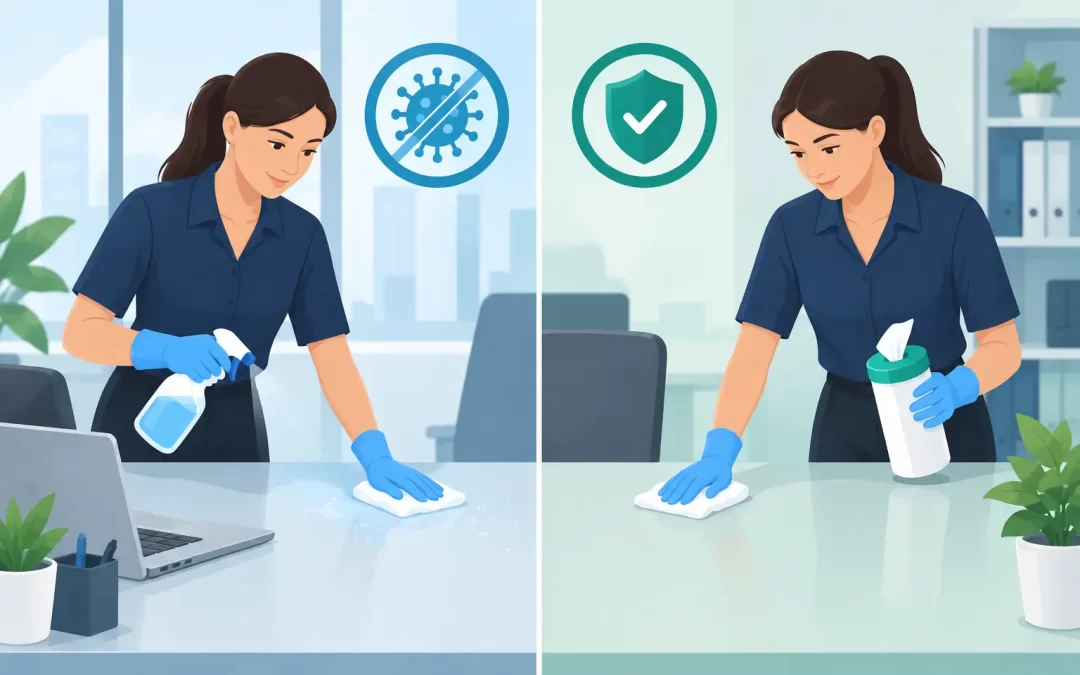
A desk can look spotless after a quick wipe and still carry contamination from the person who used it before. That is why disinfecting vs sanitising surfaces is more than a choice of cleaning product. For offices, shared housing, retail premises, kitchens, and homes, the right approach depends on the surface, the activity taking place, and the level of hygiene control required.
Cleaning teams and facilities managers get better results when they treat cleaning, sanitizing, and disinfecting as separate steps with different purposes. Using the strongest product everywhere is not automatically safer, more effective, or better value. A practical hygiene plan applies the appropriate method where it will make a measurable difference.
Disinfecting vs sanitising surfaces: the key difference
Sanitizing reduces the number of bacteria and other microorganisms on a surface to a level considered safer by public health standards. It is commonly used as part of routine hygiene in lower-risk areas and on food-contact surfaces where the product label permits that use. It helps maintain clean shared environments without always requiring a full disinfection process.
Disinfecting is designed to kill or inactivate a wider range of disease-causing germs on hard, nonporous surfaces. A disinfectant is generally used where there is a higher risk of illness spreading, after a bodily-fluid spill, during an outbreak, or in frequently touched shared areas such as restrooms, reception points, elevator buttons, and break rooms.
Neither process is the same as ordinary cleaning. Cleaning removes visible soil, grease, dust, and residues. This matters because dirt can shield germs from the chemical product placed on top of it. In most situations, the correct order is to clean first and then sanitize or disinfect according to the product directions.
Start with the risk, not the bottle
The question is not simply, “Should we disinfect everything?” It is, “What is the risk on this surface at this time?” A conference table used by a small team once a day does not require the same treatment as a restroom door handle touched by dozens of people each hour.
High-touch points deserve particular attention in commercial buildings. These include door handles, light switches, shared keyboards and mice, printer controls, phones, handrails, faucet handles, toilet flush plates, vending controls, and payment terminals. In residential settings, focus on bathroom fixtures, kitchen handles, remote controls, switches, and frequently handled devices, particularly when someone in the household is unwell.
Use disinfection where there is a known or suspected contamination risk, a high volume of public contact, or a request driven by a workplace health policy. Routine sanitizing may be suitable for regularly maintained areas where the risk is lower. This targeted approach controls costs, reduces unnecessary chemical exposure, and helps protect sensitive finishes.
When sanitizing is usually appropriate
Sanitizing is often the practical choice for daily maintenance of food-preparation surfaces, shared desks, break-room tables, and general touchpoints when no specific illness or contamination event is involved. The product must be approved for the intended surface and used at the stated dilution and contact time.
For food-contact areas, always follow the product label exactly. Some sanitizers require a potable-water rinse after treatment, while others are formulated as no-rinse products at the correct dilution. Using a general-purpose disinfectant on a food-prep counter without checking its instructions can create a safety problem rather than solve one.
When disinfection is the better response
Disinfection is appropriate after vomit, blood, or other bodily-fluid incidents, and when a facility has an increased illness risk. It is also often used in restrooms, healthcare-adjacent environments, childcare settings, and high-traffic public areas, subject to the site’s procedures and the disinfectant label.
A disinfectant service should be planned around the area’s use. For example, a restroom may need attention at several points during the day, while a training room may be disinfected after each session or at the end of the day. Frequency should reflect foot traffic, occupancy, and the nature of the work carried out in the space.
Product performance depends on correct use
A product can only perform as claimed when it is used correctly. The label is not a formality. It sets out the organisms covered, the surfaces it can be used on, the dilution rate, ventilation requirements, personal protective equipment, and the contact time.
Contact time is especially easy to overlook. A disinfectant may need to keep the surface visibly wet for several minutes before it is wiped or allowed to air dry. Spraying a surface and immediately polishing it dry can mean the product has not had time to work. On the other hand, over-wetting electronics, wood, or delicate finishes can cause damage.
Never mix cleaning chemicals. Combining products, particularly bleach-based chemicals with acids or ammonia-containing products, can release harmful fumes. Store chemicals in clearly labeled containers, keep them away from food, and ensure staff receive training on safe handling. For larger workplaces, documented procedures and product safety information should be readily available to the cleaning team.
Surface type changes the method
Hard, nonporous surfaces such as sealed countertops, glazed tile, stainless steel, and many plastic touchpoints are usually the easiest to sanitize or disinfect. Even then, compatibility must be checked. Strong chemicals used repeatedly can dull finishes, corrode metals, fade fabrics, or degrade protective coatings.
Porous surfaces need a different plan. Carpets, upholstered furniture, curtains, and untreated wood cannot always be disinfected in the same way as a countertop. Vacuuming, extraction cleaning, steam treatment where appropriate, and professional stain or contamination response may be more suitable. A surface disinfectant sprayed onto fabric without checking suitability can leave residues and does not guarantee the intended level of germ control.
Electronics require particular care. Keyboards, screens, touch panels, and phones are high-touch surfaces but vulnerable to liquid damage. Apply an approved product to a lint-free cloth rather than spraying directly onto the equipment, use only the amount needed, and avoid openings and ports. Devices should be powered down where practical before cleaning.
Build hygiene into the daily cleaning routine
The strongest hygiene programs are consistent, not dramatic. Staff and occupants should be able to see that washrooms are maintained, shared workstations are cared for, supplies are available, and issues are acted on quickly. That visible standard supports confidence among employees, customers, visitors, and residents.
A practical routine separates regular cleaning from additional response work. Daily cleaning may include removing trash, cleaning washrooms, wiping touchpoints, maintaining floors, and sanitizing appropriate shared surfaces. A separate procedure should cover spills, illness incidents, or confirmed contamination, including isolation of the area, safe disposal of waste, and use of the correct disinfectant.
Supply levels also matter. Hand soap, paper towels, toilet tissue, gloves, trash liners, disinfectant wipes, and correctly labeled chemical products should not run out midway through a busy day. Procurement teams can reduce disruption by standardizing approved products and keeping a clear reorder schedule.
For multisite properties, written checklists help maintain the same standard from one location to the next. They should identify priority touchpoints, required frequencies, the products approved for each task, and who is responsible. Supervisory inspections are useful because they confirm both visible presentation and whether cleaning procedures are being followed correctly.
Avoid the common shortcuts
A fragrant room is not necessarily a hygienic room. Likewise, a surface that looks clean may not have been sanitized or disinfected, while a heavily treated surface may still be unsafe if it was not cleaned first or the product was wiped away too soon.
Avoid relying on antibacterial wipes as a substitute for a planned cleaning program. They are useful for quick touchpoint maintenance, but they may not be suitable for every surface or every type of contamination. Avoid using the same cloth across multiple areas without changing or laundering it. Cross-contamination can move germs from a restroom or kitchen to desks, counters, and door handles.
It is also worth avoiding blanket disinfection when targeted action will do. Unnecessary chemical use increases cost, can affect indoor air quality, and may shorten the life of surfaces. Professional cleaning is about applying the right method consistently, not applying the harshest chemical available.
Aaroma supports businesses and property managers with practical cleaning, hygiene supply, and disinfectant service solutions designed around how their spaces are actually used. The right standard is the one that keeps people safer, protects the property, and can be maintained reliably every day.
The most useful next step is to walk through your property at its busiest time, identify the surfaces people truly share, and match each one with a realistic cleaning, sanitizing, or disinfecting routine.