
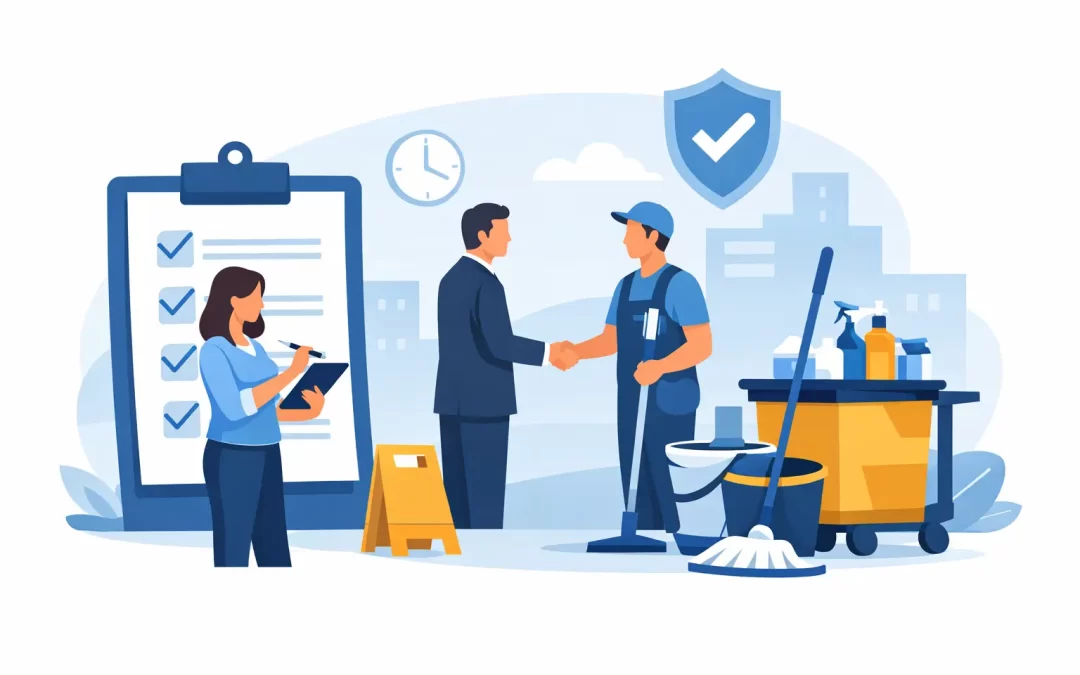
A cleaning service level agreement is where a cleaning contract becomes practical. It sets the standard for what will be cleaned, how often work will be completed, how quality will be checked, and what happens if service falls short. For facilities managers, property managers, and procurement teams, it is the document that turns expectations into accountable day-to-day delivery.
A price alone does not tell you whether a contractor will protect the appearance, hygiene, and safe operation of your premises. A well-written agreement does. It gives both sides a clear reference point, reduces avoidable disputes, and helps ensure cleaning work supports your building, staff, visitors, and customers.
Why a Cleaning Service Level Agreement Matters
Routine cleaning is often only noticed when it is missed. Overflowing waste bins, marked glass, unstocked washrooms, dusty workstations, and poorly maintained floors can quickly affect how people view a business. In some settings, such as healthcare-adjacent workplaces, food areas, schools, and high-traffic offices, poor cleaning standards can also create health and safety concerns.
The service level agreement, often called an SLA, sets measurable commitments between the client and cleaning provider. It should sit alongside the commercial contract and cleaning specification, rather than replace either one. The contract covers legal and commercial terms. The specification explains the tasks. The SLA defines the expected service level, inspection process, response times, and corrective action.
This distinction matters. Saying that washrooms will be cleaned daily is a task. Stating that washrooms must be inspected, fully stocked, odor-free, and ready for use by a defined time each day is a service level.
Start With a Clear Scope of Work
An SLA cannot fix an unclear cleaning scope. Before setting performance standards, document every area included in the agreement and the required frequency of work. This should be specific enough that a site manager and cleaning supervisor reach the same conclusion about what is included.
For an office, the scope may cover reception areas, open-plan desks, meeting rooms, kitchens, washrooms, internal glass, stairwells, elevators, and waste points. A residential block may require common-area cleaning, entrance glass, bin stores, carpets, and periodic exterior washing. Some sites also need specialist services such as carpet cleaning, floor maintenance, window cleaning, kitchen canopy cleaning, graffiti removal, or disinfecting.
Each task should state its frequency and timing. Daily, weekly, monthly, quarterly, and annual requirements are useful, but timing is equally important. A lobby cleaned at 7:00 a.m. before visitors arrive is different from one cleaned during peak foot traffic. Likewise, a kitchen may need a daytime touchpoint as well as an evening clean.
Be careful not to create a specification that looks complete but leaves major judgment calls open. Terms such as “clean as required” or “maintain a high standard” are too vague unless the agreement also defines what that standard looks like in practice.
Set Standards That Can Be Checked
The strongest service levels focus on visible outcomes, not simply hours worked. Labor hours remain relevant for pricing and staffing, but they do not prove that cleaning has been completed to the expected level.
For example, an SLA can require that hard floors are free from loose debris, obvious marks, and slip hazards after the scheduled clean. It can state that washroom consumables must be replenished before opening hours and that bins must not exceed an agreed fill level. It can require touchpoints to be cleaned and disinfected at a set frequency, with additional attention during illness outbreaks or periods of increased footfall.
Useful measures often include:
- Completion of scheduled tasks by agreed times
- Inspection scores against an agreed site checklist
- Response time for urgent spills, washroom issues, or hazards
- Availability of washroom, hygiene, and waste-management supplies
- Resolution time for complaints or failed inspections
Not every location needs the same targets. A corporate office, retail store, warehouse, apartment building, and food-service kitchen have different risks and priorities. The right SLA reflects the building’s use, occupancy, operating hours, and public-facing areas rather than applying one generic standard everywhere.
Avoid Targets That Encourage the Wrong Behavior
Measurable standards are useful, but they must be realistic. If a contractor is penalized for every minor issue found on a busy site, staff may focus on closing inspection findings rather than delivering consistent service. If response times are unreasonably short without suitable staffing, the service can become more expensive without becoming better.
Agree on what counts as a service failure, what is considered reasonable wear during the day, and which issues require immediate action. This creates fairness for both the client and contractor while keeping standards high.
Define Inspection, Reporting, and Communication
An SLA should name who checks the work and how often. Daily supervisor checks may be appropriate for larger or high-profile facilities, while monthly joint inspections may be sufficient for smaller sites. The key is consistency.
Inspection checklists should cover the areas that matter most to the site. A reception inspection might focus on floors, glass, desks, seating, and waste. A washroom checklist should cover cleanliness, odor, dispensers, paper products, sanitary bins, fixtures, and floor safety. Photographs can be useful for documenting recurring issues or confirming completed specialist work, particularly in exterior areas or after deep cleaning.
The agreement should also establish a straightforward reporting routine. This may include service reports, inspection results, supply usage, incident records, and planned periodic work. A facilities manager should not have to chase basic information or guess whether an issue has been raised.
Communication routes need to be equally clear. Identify the site contact, the contractor’s account manager or supervisor, the escalation contact for urgent issues, and the method for reporting problems. Email may be right for routine requests, but a spill, water leak, broken glass, or contamination incident needs a faster route.
Include Health, Safety, and Security Requirements
Cleaning staff often work around employees, residents, visitors, equipment, confidential information, and public areas. The SLA should confirm the operational controls required on site, including safe chemical use, wet-floor signage, secure storage, keyholding procedures, access rules, and incident reporting.
Where relevant, it should also address background checks, identification badges, uniform standards, manual handling, infection-control procedures, and training for specialist equipment. For example, carpet extraction, high-level cleaning, power washing, and kitchen duct cleaning each carry different safety requirements.
A professional cleaning provider should supply appropriate risk assessments, method statements, insurance information, and training records where required. The client, in turn, should provide accurate site information and alert the provider to known hazards, restricted areas, or changes to building access.
Clarify Supplies, Equipment, and Consumables
One common source of confusion is whether consumables are included in the cleaning price. An SLA should state who provides products such as hand soap, paper towels, toilet tissue, liners, sanitizer, cleaning chemicals, PPE, and floor-care materials.
It should also explain stock monitoring and reorder responsibility. If the provider is expected to manage washroom supplies, define the minimum stock levels, ordering process, approved product range, and lead times. This is especially valuable for sites that want one contractor to support both cleaning delivery and ongoing hygiene supply.
Aaroma’s experience across contract cleaning and cleaning supplies reflects the practical advantage of joining these responsibilities up: fewer suppliers to coordinate and clearer accountability when a site needs attention.
Build in Change Control and Review Meetings
Buildings change. Headcount grows, tenants move, opening hours shift, construction work creates dust, or a business adds new service areas. An SLA should include a simple process for changing the scope, frequency, staffing, or supplies without relying on informal conversations.
Set regular review meetings for commercial sites, usually monthly or quarterly depending on complexity. Use them to discuss inspection results, complaints, recurring issues, upcoming events, seasonal requirements, supply costs, and improvement opportunities. These meetings should be practical, not paperwork for its own sake.
The agreement should also address periodic work that does not happen every day, such as carpet cleaning, machine scrubbing, stripping and refinishing floors, deep kitchen cleaning, exterior power washing, or window cleaning. State whether these services are included, scheduled separately, or quoted when needed.
Agree on Remedies and a Fair Escalation Process
No cleaning operation is perfect every day. What matters is how a provider responds when something goes wrong. A good SLA sets response and resolution times based on the seriousness of the issue.
An immediate safety hazard should be handled urgently. A missed routine task may require correction within the same shift or by the next agreed service period. Repeated failures should trigger a documented improvement plan, additional supervision, and a review of the underlying cause.
Avoid an agreement built entirely around penalties. Service credits can be appropriate for sustained, material failures, but they should not replace active management. The best working relationships use transparent reporting, quick correction, and regular communication to prevent small issues from becoming contract problems.
A cleaning service level agreement should make it easier to judge value, not simply enforce a checklist. When standards, responsibilities, and communication are clear from the start, your cleaning provider can focus on what matters most: a safe, presentable, well-maintained property that is ready for the people who use it every day.