
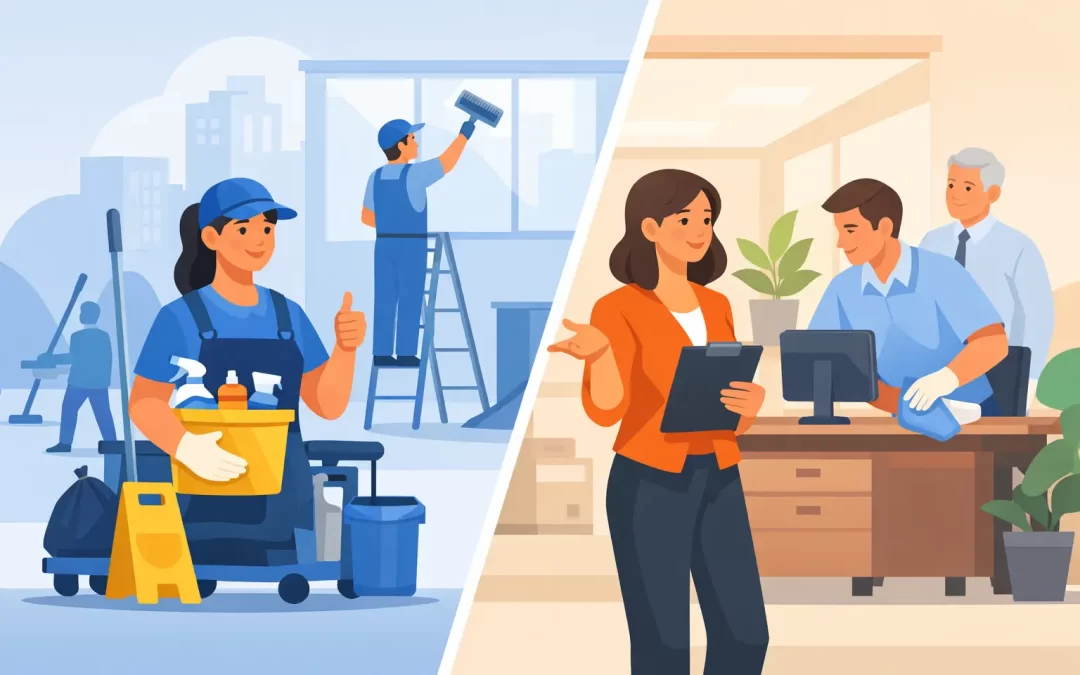
When a site starts missing the basics – dusty touchpoints, inconsistent restrooms, floors that never quite look finished – the real issue is usually not effort. It is the cleaning model behind the effort. In the contract cleaning vs in house decision, most businesses are not choosing between good and bad cleaning. They are choosing where responsibility, cost, control, and risk will sit day to day.
For office managers, property teams, and business owners, that choice affects more than appearance. It influences staff time, compliance, supply management, absentee cover, and how quickly problems get fixed when standards slip. A cheaper option on paper can become expensive once supervision, recruitment, training, and missed detail are factored in.
Contract cleaning vs in house: what is the real difference?
In-house cleaning means your business hires cleaners directly. They sit under your payroll, your management structure, and your internal processes. You recruit them, train them, cover absences, buy products and equipment, and monitor quality.
Contract cleaning means a specialist company provides the service under an agreed scope. The contractor is responsible for staffing, supervision, training, equipment, health and safety procedures, and service delivery. Depending on the provider, they may also support consumables and specialist cleaning needs under the same relationship.
That sounds simple, but the practical gap is much bigger. One model gives you direct employment control. The other gives you outsourced accountability. The right fit depends on the type of building, the hours required, the level of specialist work involved, and how much management capacity you realistically have.
Cost is not just the hourly rate
Many comparisons start with labor cost, and that is where some buyers go wrong. An in-house cleaner may appear less expensive than a contract rate, but wages are only one line in the real budget.
With in-house teams, you also carry recruitment costs, onboarding time, payroll administration, annual leave, sick pay exposure, training, uniforms, cleaning chemicals, machinery, storage, maintenance, and replacement equipment. Someone on your side also has to inspect work, handle complaints, set schedules, and solve cover issues when a cleaner is absent.
Contract cleaning usually rolls those moving parts into one service cost. That does not always mean it is cheaper in every case, especially for very small sites with simple needs. But it often makes costs easier to predict. For larger offices, managed properties, healthcare-adjacent environments, retail sites, or mixed-use buildings, the savings often come from fewer headaches and fewer service gaps rather than from a lower line-item wage figure.
The key question is not, “What is the hourly rate?” It is, “What is the true cost of keeping standards consistent every week of the year?”
Control vs accountability
This is where the debate becomes more nuanced.
An in-house team gives you direct control. You can adjust tasks quickly, change priorities on the spot, and build routines around your internal culture. For some organizations, especially those with full facilities departments and multiple support staff on site, that level of control is valuable.
But control also means the problem stays with you. If standards drop, if supplies run low, if a cleaner calls out, if a floor machine fails, your team has to fix it. In-house cleaning works best when there is active supervision and enough operational discipline to maintain standards over time.
Contract cleaning reduces direct control but increases supplier accountability. A good contractor works to a clear scope, agreed frequencies, reporting lines, and service levels. If something is missed, there is an escalation path. If labor coverage is needed, the contractor is expected to provide it. That transfer of responsibility matters for busy managers who already have security, maintenance, compliance, and tenant issues to deal with.
For many buyers, that is the real attraction. Not less involvement in standards, but less burden in running the cleaning operation itself.
Quality depends on systems, not good intentions
A common argument for in-house cleaning is that internal staff care more about the building. Sometimes that is true. Long-serving cleaners can become deeply invested in a site and notice issues early.
Still, good intentions are not a quality system. Without structured checklists, proper training, updated methods, chemical knowledge, and regular inspections, quality can become inconsistent. Work gets repeated in some areas and missed in others. Standards often depend too heavily on individual habits.
Professional contract cleaning companies are built around repeatable systems. That usually includes documented schedules, trained operatives, supervisor checks, safer chemical use, equipment suited to different surfaces, and access to specialist services when routine cleaning is not enough. If your building includes carpets, hard floor maintenance, windows, washrooms, high-touch areas, exterior surfaces, or periodic deep cleans, specialist support becomes a practical advantage rather than an extra.
That does not mean every contractor performs well. The difference between average and excellent providers is significant. Experience, insurance, staff training, service oversight, and communication standards should all be checked carefully before signing anything.
Staffing risk is one of the biggest hidden issues
Cleaning is a people-dependent service. That makes resilience critical.
With an in-house model, one resignation or one long-term absence can disrupt the whole site, especially if your cleaning team is small. Suddenly, managers are interviewing, rearranging schedules, buying emergency supplies, and fielding complaints about standards. Even when replacement staff are hired quickly, there is a learning curve.
With contract cleaning, staffing risk sits primarily with the provider. That is one of the biggest practical benefits for clients with multi-room offices, shared residential blocks, schools, clinics, retail units, or commercial premises that cannot afford visible lapses. Coverage should be built into the service model.
This is also where scale matters. An experienced contractor can pull from a wider labor pool, supervisory structure, and equipment base than most individual sites can maintain on their own.
Compliance, safety, and insurance are not side issues
Cleaning is often treated as a basic support task until there is an accident, a chemical misuse issue, or a service complaint tied to hygiene. Then it becomes very serious, very quickly.
In-house cleaning means you are responsible for training records, risk assessments, manual handling, COSHH-style chemical controls, equipment safety, and employment compliance. If you have the internal systems to manage that properly, fine. If not, the risk exposure is higher than many businesses realize.
A professional contractor should bring established procedures, trained operatives, method statements where needed, and appropriate insurance backing. That matters in busy offices, public-facing environments, shared facilities, and any space where hygiene and slip risk can affect staff and visitors.
For procurement teams and facilities managers, this point alone often changes the decision. Cleaning should support compliance, not create another management gap.
When in-house cleaning makes sense
In-house cleaning can work well in a narrow set of conditions. If you have a single site, predictable cleaning needs, a strong internal facilities function, and enough scale to supervise staff properly, it can offer flexibility. It may also suit businesses that want cleaners fully embedded in the organization and are willing to invest in training, management, and backup cover.
It tends to be more viable when the work is straightforward and does not require frequent specialist services, technical floor care, exterior work, or complex consumables management.
The problem is not that in-house cleaning cannot work. The problem is that many businesses underestimate what it takes to run it well.
When contract cleaning is the better fit
Contract cleaning is usually the stronger choice when reliability, coverage, and consistency matter more than direct day-to-day control. It is especially effective for businesses that want one accountable provider rather than multiple moving parts.
That includes offices that need regular cleaning plus consumables, properties that require common-area maintenance, sites with periodic carpet or window work, and businesses that want standards maintained without managing every staffing issue themselves. A provider with broad service capability can also reduce the need to source separate contractors for specialist tasks.
For many organizations, that is where the value is found. Not just in labor, but in coordination, service continuity, and reduced administrative drag. That is why companies such as Aaroma are often brought in not only to clean, but to support broader facility hygiene needs with practical, experienced oversight.
The better question to ask
Instead of asking whether contract cleaning or in-house cleaning is better in general, ask which model best fits your building, your risk profile, and your management capacity.
If you have time, internal expertise, and stable staffing, in-house may suit you. If you need dependable standards, easier coverage, specialist capability, and clearer accountability, contract cleaning will often deliver better value over time.
The right cleaning setup should make your operation easier to run, not harder. That is usually the clearest sign you have chosen well.