
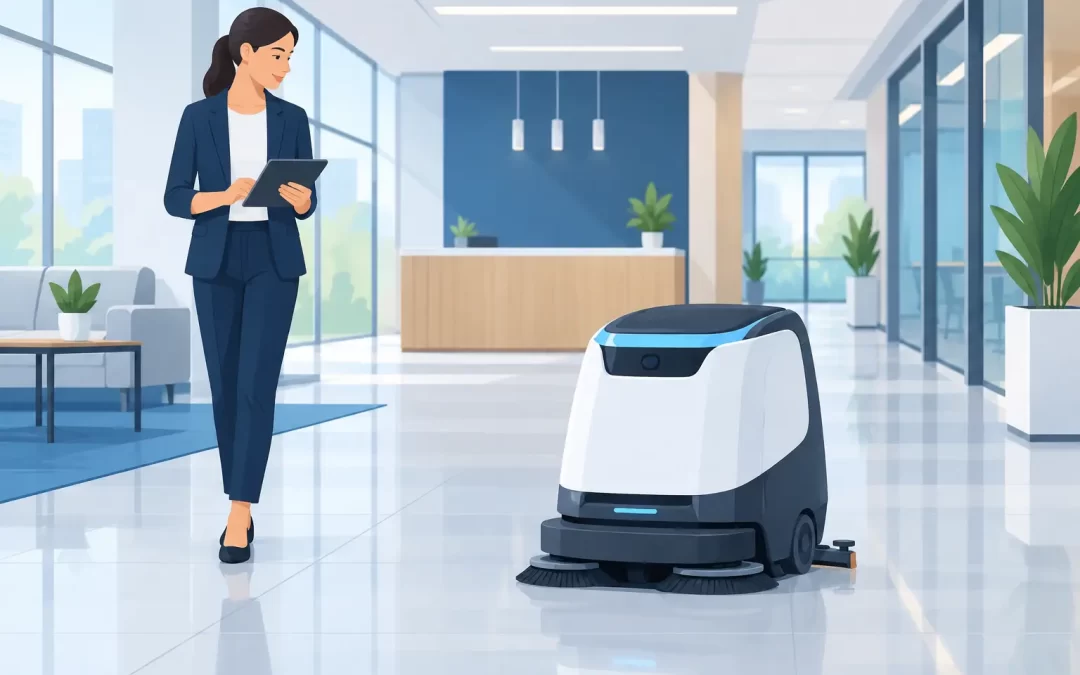
A robotic floor machine can cover a large, open lobby while the cleaning team handles restrooms, touchpoints, glass, kitchens, and the detail work guests notice first. That is the most useful way to view robotic cleaning: not as a replacement for professional cleaners, but as another piece of equipment that can improve consistency in the right setting.
For facilities managers, property managers, and business owners, the question is not whether a robot looks impressive during a site visit. It is whether it improves cleaning standards, uses labor sensibly, fits the building safely, and delivers value over the life of the contract. The answer depends heavily on the floors, traffic patterns, operating hours, and level of supervision available.
What robotic cleaning is designed to do
Robotic cleaning equipment is most commonly used for routine hard-floor maintenance. Depending on the machine, it may vacuum, sweep, scrub, dry, or run a programmed cleaning route across a defined area. Sensors, mapping technology, and obstacle detection allow the unit to work around fixed features and, in some cases, changing activity on the floor.
Its strength is repetition. A robot can follow the same route through a warehouse aisle, office corridor, retail floor, or common-area lobby each day. That makes it useful for maintaining a baseline of floor appearance between deeper cleaning visits or during periods when a site needs more frequent attention.
The equipment is less effective when the work requires judgment. A robot cannot decide that a spill needs a different chemical, spot hidden dirt behind furniture, remove gum from an entrance, clean a keyboard, detail a stairwell, or respond properly to a washroom complaint. Those tasks still need trained people, correct supplies, and accountable supervision.
Where robotic cleaning delivers the strongest value
The best sites tend to have broad, predictable floor areas with limited clutter. Distribution facilities, education campuses, office buildings, retail spaces, medical waiting areas, and apartment common areas can all be good candidates. Large hard-floor spaces are particularly suitable because they allow the machine to work for longer periods without frequent interruption.
A well-planned office can benefit from a robot running after staff leave, keeping corridors and open work areas presentable before the morning shift. In a warehouse, the same approach can support regular floor care in designated zones, provided forklift routes, pedestrian movement, loading activity, and safety controls have been considered.
Floor type matters as much as square footage. Smooth sealed concrete, vinyl, tile, and similar hard surfaces are generally more suitable than heavily textured floors, loose mats, deep grout lines, crowded carpeted areas, or spaces with constant furniture movement. A site survey should assess drainage, thresholds, ramps, charging locations, door access, and the condition of the floor before any equipment is selected.
A robot is most useful when the route is stable
A robot performs better when tables, displays, pallets, cables, and bins are not moved across its route every day. It can adapt to some obstacles, but frequent changes reduce efficiency and can create missed areas. In a busy public setting, scheduling the machine outside peak hours is often the more reliable option.
That does not mean a building needs to be empty. It means the cleaning plan needs realistic expectations. A machine working in an active environment requires clear operating rules, staff awareness, and a responsible person who can intervene if conditions change.
The benefits beyond labor savings
Labor savings are often the first benefit discussed, but they should not be the only measure. Robotic equipment can help a cleaning operation use skilled staff where they create the most value. Instead of spending an entire shift repeatedly scrubbing open floor space, a trained cleaner can focus on high-touch disinfection, washroom hygiene, edge work, stain treatment, windows, waste, and quality checks.
This can improve visible results because the team has more time for tasks that machines cannot perform well. It can also support more regular floor maintenance, reducing the build-up of dirt that contributes to dull finishes, premature wear, and costly restoration work.
Consistency is another advantage. When the route, chemical dilution, pad selection, and frequency are controlled, the machine can carry out routine work to an established standard. For facilities with multiple shifts or varying foot traffic, documented machine schedules can also make it easier to show that planned cleaning has taken place.
There is a sustainability consideration as well. Properly configured equipment may use water and solution more precisely than an inconsistent manual process. However, that benefit depends on the machine being maintained, correctly programmed, and paired with suitable cleaning products. Automation does not compensate for poor chemical selection or neglected floors.
The limits facilities should plan for
Robotic cleaning has real operating requirements. Machines need charging, clean water, waste-water disposal, routine cleaning, consumables, software updates where applicable, and periodic maintenance. Someone must inspect the unit before and after use, check brushes and squeegees, empty recovery tanks, and make sure the machine is ready for the next shift.
There is also an up-front cost. For a small office with limited hard flooring, conventional professional cleaning may remain the better value. The case becomes stronger where there is enough repeatable floor area and enough cleaning frequency to justify the investment.
Safety must be addressed before deployment. A machine should not be treated as an unattended appliance. Facilities need suitable risk assessments, clear charging arrangements, defined operating zones, and procedures for spills, blocked routes, alarms, and manual overrides. Staff should know who is responsible for the equipment and how to report a problem.
Security and privacy may also matter. Some machines use cameras or other sensors for navigation. Where a robot operates in offices, healthcare environments, residential developments, or secure premises, the facilities team should understand what data is collected, where it is stored, and whether site policies place limits on its use.
Building a practical robotic cleaning plan
Start with the outcome, not the machine. Define what the site needs: cleaner entrance floors by opening time, more frequent maintenance in a busy corridor, reduced soil on a warehouse route, or extra support for an existing evening team. A clear goal makes it easier to determine whether robotic equipment is appropriate.
Next, measure the usable area rather than the entire building footprint. Exclude staircases, cramped rooms, furniture-heavy zones, irregular corners, and areas requiring specialist cleaning. Then review the floor condition. If the surface has deep staining, damaged finish, grease, or embedded dirt, restorative cleaning may be needed before a robot can maintain it effectively.
A pilot period is valuable. Test the route at the intended operating time and review the results after several cleaning cycles. Look at actual coverage, battery performance, water use, interruption rates, access issues, and the condition of edges and corners. Most importantly, ask whether the cleaning team has gained useful time for higher-value work.
Professional oversight remains essential. The strongest approach is usually a combined service plan: robotic equipment handles planned, repeatable floor runs, while an experienced cleaning team completes the detailed, responsive, and specialist tasks. This keeps standards high without expecting one tool to solve every hygiene and maintenance need.
Choosing the right support partner
A supplier should be able to discuss more than the machine specification. They should understand cleaning chemicals, floor finishes, safety documentation, operator training, maintenance schedules, and the daily realities of a working facility. If equipment is introduced without this operational support, it can quickly become an expensive unit parked in a storage room.
For Dublin facilities that need both day-to-day cleaning and specialist support, Aaroma can help assess where automation fits within a wider cleaning program. More than 25 years of practical cleaning experience matters when deciding which work should be automated and which work still needs skilled hands.
The right robotic cleaning program should make the building easier to manage, not create another task for your team. Begin with the floors, people, and standards that matter most, then use technology where it produces dependable, visible results.